A Late History of Parma
Introduction
When your Wikipedia page has three separate sections devoted to rebirth, that’s a sign of an endemic problem within your organization. Indeed, the football club of one of the world’s most famous historical cities has taken on no less than 7 names in its less-than-illustrious history. In a club with its history of financial scandal it is hard to select just one, but for the purpose of this blog post I will focus on the Parmalat scandal of the early 2000’s which not only destroyed Parma’s club but also its largest source of industry.
Parmalat was founded in 1961 by a young 22 year old (fantastically) named Calisto Tanzi. Despite its inauspicious start as a ham retailing company, Parmalat exploded onto the Italian commercial scene in the 1980’s and by the 1990’s the company had expanded worldwide. By the early 2000’s, Parmalat maintained a nearly 50% market share of dairy products in Italy ( see pg 44 of link) and employed over 36,000 people. Tanzi and his family were royalty in Parma and along with the Barilla family (yes, the pasta), occupied a quasi-celebrity status in his hometown. However, while Barilla was built on a solid foundation, Parmalat was not. But before the collapse, it is worth recognizing the on-field prowess this historically feckless team was able to achieve during a glorious 10 year period.
A Taste of Success
Parma gained promotion to the top flight of Italian Football, Serie A, in the 1989-90 season. Funded by Parmalat, Parma were to get down to business in Serie A. Their first win was a 1-0 win against Diego Maradona’s Napoli and the season was to finish in a noteworthy sixth place in the table and qualification for European competition. The team was built on solid foundations with future Italian international central defenders Luigi Apolloni and Lorenzo Minotti in defense and Alessandro Melli leading the line up front. These players were a crucial part of Serie B promotion but, upon reaching Serie A, the team was also able to add further quality to the team. One crucial signing was Thomas Brolin (AKA Fat Boy Brolin). Brolin later became ridiculed England but he was key in Parma’s early success. In 1992, Parma won their first trophy in the Italian Cup, defeating Juventus in the final.
Trophies and Legends
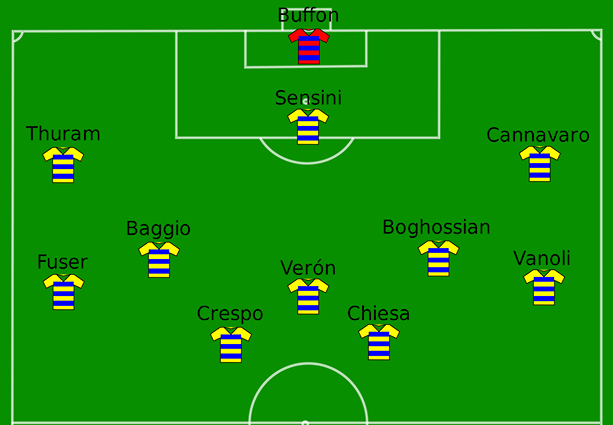
1993 brought one of the club’s finest hours, as the club hoisted the now defunct European Cup Winners Cup with a 3-1 win over Belgian club Antwerp in Wembley Stadium. By then Parma had been bolstered by the likes of the mercurial Faustino Asprilla and Gianfranco Zola (who had arrived in the summer of 1993). These two additions helped Parma to a European Super Cup win in the Autumn of 1993. Nestor Sensini and Dino Baggio both arrived at Parma in 1994, and 1995 saw Parma win the UEFA Cup for the first time, beating Juventus 1-0 in a typically Italian defensive matchup. Parma’s greatest success perhaps occurred in 1999 when Parma again won the UEFA Cup, beating Marseille 3-0 in the final. The team on that day had some of the greatest names in football history and perhaps was one of the best teams ever assembled. The team had over 700 international appearances and 4 world cup medals between them (not counting the other medals won by Buffon and Cannavaro in 2006).
A Black Hole
This amazing run but Parma among Italy’s elite clubs but there was trouble on the horizon. In 2013, Parmalat had difficulties paying a €150m bond yield which was puzzling for a company with €3.9bn sitting in reserves in a Bank of America account. Initially the company said there were no problems but later revealed that the €3.9bn never actually existed. The company was in instant turmoil. Calisto Tanzi was arrested and the ensuing investigation revealed the scope of the problem: the company had a €14.3bn black hole in its account. The money never existed. Parmalat went bust and the Italian government had to step in to pay creditors. Parma’s best players were sold. Despite all of this upheaval, Parma was allowed to form a new name through a clever loophole and continued to participate in Serie A. Tanzi was sentenced to 17 years in prison and he is still currently serving his sentence. Parma itself fared rather worse, getting the death penalty and being forced to dissolve in 2015.
What to Make of it all?
Kevin Nolan of These Football Times writes of Parma during this time “Off the pitch, Parma’s fairy tale was a sham and a lie. On it, however, the fairy tale was a distinct reality”. People now fondly look back on the Parma team with a sort of reverence and while it is remarkable that the team was able to compete amidst all of this turmoil, it is worth paying mind to the fact that many regular people, local supporters of the team were deeply affected by the collapse of Parmalat. Of course the team deserves praise but when the owners cause so much pain and suffering it is worth wondering if one can truly separate the owners off the pitch from the beautiful spectacle on it.
P.S. This story does indeed have a bit of a happy ending. Parma, once again rising from the ashes, was reformed in 2015 in Serie D (the 4th tier of Italian football). It took the court 10 minutes to declare the club bankrupt and resign them to their fate and considerably longer to return to the top division but as of the publishing of this blog post, Parma are back in Serie A. This article from The Guardian is a good timeline in to how this remarkable club once again captured the hearts and minds of Italy.
 Football Through Finances