Money and Competition Among Premier League Clubs
Americans love parity in our sports. As much as we opine about the dynasties of the Yankees, Bulls, or Patriots, American sport is characterized by competitive balance. Major professional leagues in the states have measures such as a draft or salary caps which keep a somewhat level playing field between the teams. Sure there are those who abuse the system (Trust the Process) but overall these competitive measures have largely done their job. Systematic measures which maintain competitive balance are almost totally absent from world football. Although these imbalances are prevalent throughout world football, this post will focus solely on the Premier League.
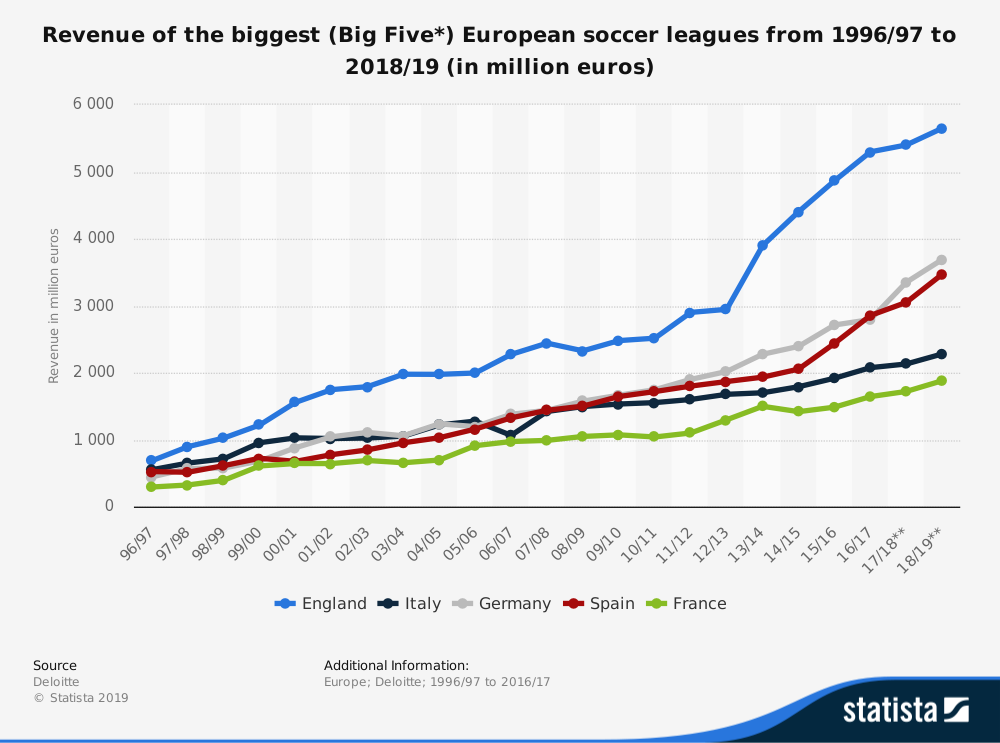
The Premier League has the highest revenues of any professional football league in the world. In one of the league’s few competitive balancing schemes, the league’s massive television revenue is split between the 20 teams. All 20 teams receive $46 Million for domestic (English) TV income, $54 Million for overseas TV income and $6.4 Million for central commercialization. All told, the last placed team in the 2017/18 season, West Bromwich Albion, received nearly $125 Million from television money and prize money. The amount of money floating around the Premier League is, quite frankly, ridiculous. According to accounting firm, Deloitte (who has put out the list of most valuable football clubs every year since 2002), 13 of the top 30 most valuable clubs in the world are English. Sevilla and Lyon, who routinely play in latter stages of prestigious European competitions, lag behind perennial Premiership bottom-feeder, Crystal Palace.
Two Questions
What are these teams doing with the money? Conventionally speaking, there are six teams whose resources and clout vastly outrank the other 16 teams. Manchester United, Manchester City, Arsenal, Chelsea, Tottenham, and Liverpool compete with each other for the top 4 places. Teams who finish in 5th, 6th, and sometimes 7th (depending on a number of factors such as cup wins) get to compete in the Europa League (the little brother of the Champions League). What has effectively happened is a bifurcation of the Premier League – the top clubs competing for Champions League places and the bottom of the league fighting for survival. The number of clubs in “mid-table” has shrunk year after year as the top of the league gradually grows more and more out of sight. Teams outside the top six compete for “best of the rest” as opposed for 1st place. Some owners realize they will never be able to compete with the top six teams and siphon money into their own pockets. Other clubs spend big in the transfer market, to varying degrees of success.
Is this money bringing these teams success? The answer, in my opinion, is a resounding no. The top six teams, with their abundance of riches, have only managed to have one team in a Champions League final in the past 5 years. An English team has not won the Champions League since Chelsea pulled off an unexpected victory in 2012. Only one English team has won the Europa league in the past 5 years (Manchester United in 2017). For all their resources, to win 1 out of a possible 10 European titles in the past 5 years is a disappointing return. Aside from the top 6, ROI has been equally unimpressive. Just this season, newly promoted side Fulham spent in excess of $131 Million. This was more than Manchester United and Arsenal. Now, at the time of writing, Fulham sit in the relegation zone having already fired their manager this season. In fact, the only team outside the top 6 to win the title since 1995/96 was Leicester City in 2015/16. That year, Leicester spent only $56.6 Million, 14th in the league.
Conclusion
The influx of money into the Premier League has done very little to increase club performance on the intercontinental level (I say very little as opposed to nothing because this year English teams seem to have bucked the trend. All of the top 6 teams are currently in the quarter finals of either the Champions League or Europa League at the time of writing). While the top 6 teams do not have the quality to perform in Europe, the gap they have opened between themselves and the rest of the league has had negative effects at home. Clubs either have no incentive to spend money (i.e. Newcastle United) or spend too much trying to compete and become Icarus (i.e. Fulham). While American sports leagues seem to stress the importance of competitive balance, it seems their fears of disinterest amidst single team domination seem unfounded. The Premier League (and football in general) are still immensely popular and appears to be for the foreseeable future.
 Football Through Finances